
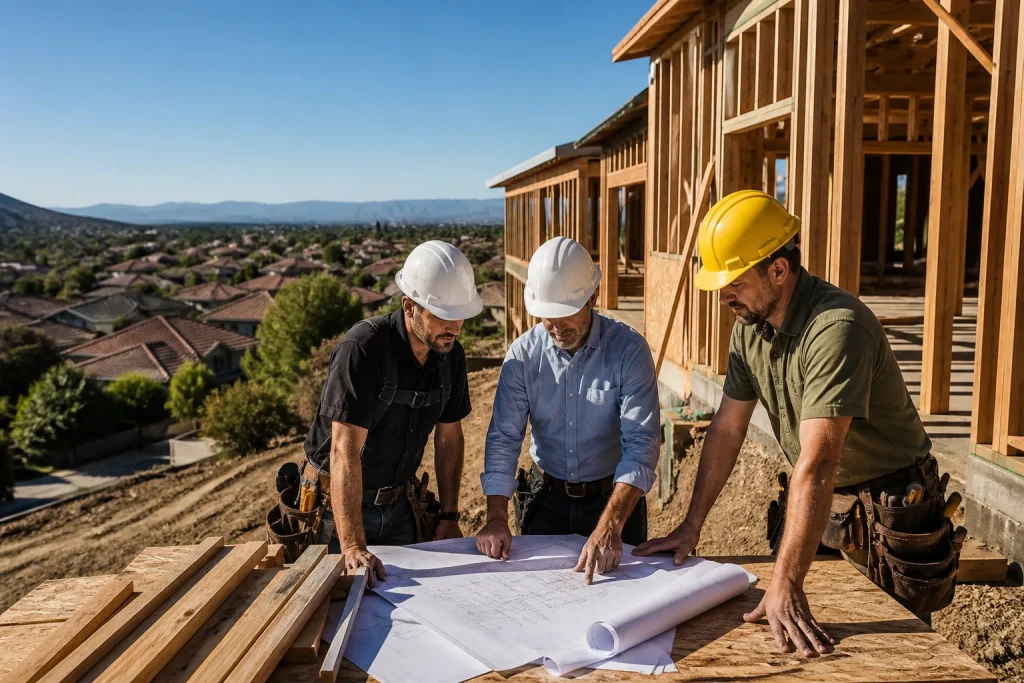

How to Choose the Right Construction Company in Orange
The contractor with the warmest handshake and the longest review thread can still wreck your timeline if they’re juggling six jobs without a dedicated project manager. Choosing well in Orange, CA comes down to operational capability, not likability. Most renovation disasters aren’t craft failures; they’re logistics failures. So before you sign anything, you need to know how a company schedules, who runs the trades, and what happens when a phase slips.
Here’s how to separate a contractor who can actually carry a multi-trade project from one who just talks a good game. And if you’d rather not DIY the vetting, call (844) 797-4821 and a free estimate comes with straight answers to every question below.
Key Takeaways
- Ask about current workload and crew structure before you ask about price.
- A single-source general contractor reduces your liability exposure across trades.
- A formal manufacturer purchasing relationship protects your material warranty chain.
- Read the change-order and lien-waiver clauses, not just the line-item totals.
- Local familiarity with Orange inspectors and HOA rules carries real dollar value.
How do you evaluate a contractor’s real scheduling capacity?

You evaluate capacity by asking three specific questions before you talk price: how many active jobs are running right now, who manages your project day to day, and what your crew looks like on a typical week. A contractor who can answer all three without hesitating is a contractor who actually tracks their schedule.
- How many active jobs are you running right now? If the number is high and the company is small, someone is getting juggled. You want to hear a realistic figure, not a reassuring one.
- Who is my dedicated project manager? A name, a role, and a phone number you can reach. If “the crew” is the answer, there’s no coordination layer, and multi-trade work without one drifts.
- What does the next four weeks of my project look like on paper? A real scheduler can sketch milestones. A vibes-based contractor will tell you to relax.
In our experience, the sharpest tell is how they talk about how they handle conflicts between two active jobs. A coordinated operation knows exactly how it’s sequencing them. In Orange, where permits and inspections run through the local building department, a missed inspection slot can cascade into delays fast, so a company that respects its own calendar tends to respect yours too.
What licenses should a general contractor in Orange, CA hold?
A general contractor in Orange, CA should hold a Class B General Building Contractor license from the Contractors State License Board (CSLB), which lets them take on multi-trade projects where several specialties are involved. They should also carry a current license, active insurance, and workers’ compensation coverage. You can verify any license number through the CSLB before you sign.
A Class B license covers the general building work and lets the company manage and coordinate specialty trades on your project. It doesn’t replace the specialty sub-licenses needed for things like certain electrical or plumbing scope, so on a job that touches multiple trades, the licensed GCs on the roster should either carry the right classifications or bring in properly licensed specialty contractors.
Here’s why this matters: when several trades are working under one licensed general contractor, responsibility is centralized. If a window install and a roofing repair disagree over who owns the flashing detail, you have one point of accountability, not two separate companies pointing fingers. That’s the liability- exposure argument for a single-source GC, and it’s the one most homeowners never hear until something goes wrong.
We help homeowners verify this on the front end. If any part of the licensing picture is fuzzy, that’s a red flag worth walking away from.
“Works with” a brand versus a formal purchasing relationship: what’s the difference?

A contractor who “works with” Kohler or Toto has installed their products before. A contractor with a formal supplier or installer relationship has access to the manufacturer’s specification support, warranty chain, and material availability. Those are very different things when you need a fixture replaced or a warranty honored six months after the job wraps.
Ask this plainly: “Is your relationship with this brand direct, and does the warranty flow through you or do I file it myself?” On a real relationship, the paper trail between manufacturer, installer, and homeowner stays intact. On a handshake, the moment the fixture fails, you’re the one navigating the warranty claim alone.
- Formal relationship: defined material choices, spec-match on your project, warranty documentation that travels with the install.
- Informal “works with”: whatever they can pick up locally, and warranty paperwork left in your lap.
For faucets and fixtures, this is a meaningful ask. Delta and American Standard both make reliable product lines from value tier to premium, and where a contractor buys affects both what’s actually available to you and what happens when a part needs work.
What contract clauses protect the contractor at your expense?
Three clauses deserve close reading on any Orange construction contract: change-order language, completion milestones, and lien waiver timing. Vague change orders let a project run over budget without your written sign-off. Undefined milestones leave the schedule open-ended. And lien waivers that aren’t timed correctly to each payment can leave you exposed if a subcontractor walks.
- Change orders. The clause should require written, signed approval for every scope change and every dollar of it, with a clear process. “Reasonable adjustments as needed” is the wrong language.
- Completion milestones. Your contract should break the job into phases with dates or clear triggers. A single “upon completion” line means there’s no schedule to hold anyone to.
- Lien waiver timing. Whoever is paid at each draw should issue a conditional lien waiver tied to that payment. If the timing is fuzzy, ask exactly when the waiver is delivered and who signs it.
- Written estimate as the price. The line-item estimate sets the final price. Get it in writing, and make sure the contract references it.
None of this is hostile toward the contractor. It’s the difference between a project with rails and a project that stays on good behavior purely through hope.
How much does local market knowledge really save you in Orange?

Local market knowledge saves money in concrete ways: fewer failed inspections, fewer material surprises, fewer HOA disputes. A contractor who knows the Orange building department’s inspection rhythm and the local soil and grade conditions builds a schedule that holds up. One based three counties away learns on your dime.
Three areas where it shows up:
- Inspectors and permits. Familiarity with how the local office schedules and reviews means fewer rejections and faster corrections when something comes up.
- Regional conditions. The area’s mild winters draw a specific set of material and grading decisions for slip grades, drainage, and exterior finishes. A distant crew applies generic assumptions that cost you later.
- HOA norms. Orange HOA rules on fencing, patios, and exterior finishes vary street to street. A contractor who already knows the rhythm of local HOA review saves weeks of back-and-forth and rework.
Put a number on it: every inspection re-visit and every rejected finish is a delay you pay for in time and often in change orders. The dollar value of local familiarity is real, and it isn’t a soft benefit.
When to call a pro, and how to check the work
There’s a point on any multi-trade project where the coordination load passes what a homeowner can carry. The moment your project touches three or more trades, or a permit and a specialty inspection, it’s time to bring in a general contractor. Before hiring, ask for the license number, the written estimate, and the project manager’s name, then verify all three.
If any of this seems like a lot to sort through alone, it is. That’s the job. A good general contractor does the sorting for you.
From the curb to the ridge, a single-source operation covers the scope that a narrow remodeler can’t: driveway & pavers at the front of the property, fence installation along the boundary, home additions & ADU when the house itself needs to grow, and the roofing, windows, and interior work in between. That’s the Construction Orange model, and it’s why we ask the questions we’d want asked of us.
The Bottom Line
The right construction company in Orange is the one whose operational machinery can carry your project, not the one who charms you at the first meeting. Check licensing, ask about active workload and crew structure, confirm whether brand relationships are formal, read the contract clauses carefully, and value local knowledge for what it actually saves. If a company can answer all that without blinking, you’ve found your crew.
Our technicians have up to 12 years of experience, and we know the difference between a job that runs cleanly and one that limps across the finish line. So if you’re in Orange and need help, Construction Orange offers free estimates. Call (844) 797-4821, or request a written, line-item quote and we’ll walk through your project from there.
Frequently Asked Questions
Yes. A multi-trade project should be run by a general contractor holding a Class B General Building Contractor license from the state, along with active insurance. Verify the license through the CSLB before you sign, and confirm which specialty trades are being coordinated under that license.
Ask them directly how many active jobs they’re running and who manages yours day to day. If they can’t answer both cleanly, treat that as a scheduling red flag. You want a realistic number and a named project manager, not a reassurance.
A formal relationship means the warranty chain, material availability, and installation specs are documented and travel with the job. “Works with” often just means they’ve installed the product before. Ask whether the warranty flows through them so you know what happens when something fails.
It usually costs more in delays. A company unfamiliar with the Orange building department and local HOA norms spends time learning on your project, and every failed inspection or rejected finish adds delay. Local familiarity has real dollar value. Call (844) 797-4821 for a free estimate.
Written by the team at Construction Orange.
Need Construction Help?
Call Construction Orange - licensed & insured, here with fast help in Orange.
(844) 797-4821