Last updated November 18, 2026



Free written scope consultation - allowances, timeline, and change-order rules on paper before a single trade is scheduled
Driveway & Pavers Troubleshooting in Orange: Common Problems and How to Fix Them
If your pavers are rocking, cracking, or sprouting weeds, replacing them without fixing the real cause is like painting over mold. You’re just resetting the clock on the same failure. In our experience across Orange, most homeowners blame the paver itself when the actual culprit is underneath: a shallow base, a missing slope, or water with nowhere to go. That misdiagnosis is expensive. A surface patch looks fixed for a season, then the joints open and the stones shift again. This guide teaches you to read your driveway the way a contractor does, using a garden hose and a straight edge, so you know whether you’re facing a re-sand or a full rebuild before anyone quotes you a number in Orange.
Quick Answer
Most driveway paver problems in Orange come down to one of three causes: a base that wasn’t compacted deep enough, water draining toward the house instead of away, or joint sand that washed out after a few dry seasons. Before you call anyone, run water across the surface and watch where it pools, then lay a straight edge across the stones to check for rocking. If the stones move underfoot and the slope is wrong, you’re looking at a rebuild. If the stones are solid and only the sand and weeds are the issue, re-sanding and re-compacting will usually bring a driveway back. A written scope of work from the contractor tells you which one you’re actually buying.
Styles & brands we work with
- Kitchen remodeling
- Bathroom remodeling
- Home additions & ADU
- Roofing
- Windows & doors
- Driveway & pavers
- Fence
Table of Contents
- How to read your driveway before you call anyone
- Base failure vs. settling vs. drainage: telling them apart
- Failure patterns specific to Orange driveways
- When re-sanding and re-compacting saves the driveway, and when it doesn’t
- Efflorescence: cosmetic haze or warning sign?
- What a legitimate repair scope of work looks like in writing
- Common mistakes to avoid
- When to call a professional
How to Read Your Driveway Before You Call Anyone
You can diagnose most paver trouble with two things you already own: a garden hose and a straight edge, a level, or a four-foot board. This is the same first pass a contractor makes. You’re looking for two signals, drainage and movement, and you want to know them both before anyone quotes you a repair.
Start with water. Set the hose on a low flow at the high corner of the driveway and let it run for a few minutes. Watch the sheet of water and note where it slows, spreads, or pools. Water is honest. It tells you the true grade of the surface and reveals the low spots that a dry driveway hides. On a well-built driveway, water leaves the surface and heads for a drain, a swale, or the street. When it pools against the garage door, sits mid-panel, or soaks into a joint and disappears, you’ve found the source of most of the problems below.
Then check movement. Lay your straight edge across several pavers in different directions and press down on one end. Rocking is movement you can feel through the board. A paver that rocks is sitting on a void, and a void means the base beneath it has failed or washed out. Tap the stones with a screwdriver handle and listen; a hollow note, compared to a dull solid thunk, points to the same void. Write down what you find, because this short list is exactly what a contractor needs to hear to give you a useful scope instead of a full replacement.
We see this constantly in Orange, where driveways sit on soil that shifts with the long dry season and then takes on a heavy winter rain. Reading the driveway first keeps you from buying demo you don’t need. If you want the larger picture on what a properly built driveway involves, our driveway & pavers page walks through the layers from soil to surface.
Base Failure vs. Settling vs. Drainage: Telling Them Apart
These three problems look alike from standing height, but they need very different fixes. A base failure is a construction problem: too little compacted aggregate under the pavers. Settling is usually a local void, one area that washed out or was never filled. Drainage is a grading problem: the surface was built level when it should have been sloped, or the outfall was never provided. Mixing up which one you have is the most expensive mistake in paver repair.
- Base failure: the pavers move across a wide area, joints open and close by season, and the whole panel feels loose underfoot. A straight edge shows the stones dipping together in broad depressions. This is the rebuild case.
- Settling: one or two stones rock while their neighbors are solid. The problem is a localized void, often near a downspout, a lawn edge, or where a vehicle parks repeatedly. Lifting, re-leveling, and re-setting that small section is usually enough.
- Drainage: the stones are firm but water stands after a rain or dark stains appear at the garage threshold. The material is fine; the slope is wrong or the outlet is missing. Fixing it can mean re-grading, adding a channel drain, or re-laying the affected row.
A quick check that separates them: water the suspect area and watch how long it takes to drain. Fast disappearance into a joint with a hollow tap below points to base loss. Slow pooling with solid stones points to grade. Fast movement of the whole panel points to base construction. Once you know which of the three you have, the repair conversation gets honest. In Orange a lot of driveways were laid decades ago for lighter cars and a different drainage map, and that history shows up as one of these three patterns.
Failure Patterns Specific to Orange Driveways
Our climate leaves a particular fingerprint on paver driveways. We don’t get deep freezes, so the damage isn’t from ice heaving apart the joints. What we get instead is a long dry stretch that lets the soil shrink, followed by concentrated rain that finds the gaps. That combination produces a few patterns you’ll recognize if you’ve owned a home in Orange for more than a few summers.
Thermal expansion gaps. A paver driveway in full afternoon sun gets hot, and the pavers expand and push against one another. Where restraint at the edge is weak, that push widens joints and can raise a slight ridge. You’ll see this as a line of open joints along the sun-facing side and a lip where two panels meet. A driveway without proper edge restraint has nothing to hold that expansion in check.
Oil and organic staining. Vehicle oil is universal, but in Orange we also fight staining from the sap and dropped fruit of the palms and street trees that shade a lot of driveways. The residue works into the surface and darkens the stones. Some of it lifts with a good cleaner; some of it has soaked into the paver and needs a different approach. Worth knowing before you decide the pavers are stained beyond saving.
Root intrusion. Street trees and mature landscaping nearby send roots running toward the moisture under a driveway. They lift pavers along one edge and creep into joints, and they open the door to weeds. The pavers aren’t the problem here; the root is. A repair that resets the stones without addressing the root or the joint width will look right for a season and then heave again. Our Construction Orange team treats these three patterns separately because each one has its own fix.
When Re-Sanding and Re-Compacting Saves the Driveway, and When It Doesn’t
Re-sanding and re-compacting rescues a driveway when the pavers themselves are sound and the base is intact. The stones aren’t moving; the joint sand has simply washed or blown out, weeds have taken hold, and the surface feels loose because the interlock between pavers is gone. In that case, a proper re-sand resets the interlock and can restore the driveway for years. It’s the right call more often than homeowners expect.
Re-sanding is the answer when:
- The stones are solid underfoot across most of the surface and don’t rock when you press them.
- Joints are open and sand is missing, but the pavers sit at the same height as their neighbors.
- Weeds are sprouting from joints rather than from lifted or heaved stones.
- The slope still sheds water properly, and there’s no pooling after a rain.
A full base rebuild is unavoidable when the failure runs deeper than the surface:
- A whole panel rocks underfoot, or the straight edge shows broad dips where the pavers sink together.
- Individual stones sit noticeably lower or higher than their neighbors, and the difference remains after a rain.
- Water pools and stands on the driveway for days, or runs toward the garage instead of away.
- Pavers are cracked, chipped, or crushed across a large area, not just worn from traffic.
- Joints keep opening up no matter how often they’re re-filled.
The honest test is the one you did with the hose and the straight edge. Firm stones plus missing sand means re-sand. Rocking panels plus poor drainage means rebuild. Any contractor who skips straight to full replacement without running that test, or who quotes a rebuild for a driveway that only needs re-sanding, is selling you work you don’t need. Material choice matters here too, and our paver lineup across seven brands, from Belgard to Tremron, lets us match the fix to what’s actually on your driveway. If foundation-level repairs and drainage re-grading are part of the scope, it helps to have the full property examined at once, which is why many Orange homeowners bring us in to look at the driveway alongside their fence installation needs and the grading that ties the two together.
Efflorescence: Cosmetic Haze or Warning Sign?
Efflorescence is that white, chalky film that can bloom across pavers after a wet stretch. It’s mineral salts carried to the surface by moisture and left behind as a deposit. On some pavers and some brands it’s purely cosmetic and lifts on its own after a dry spell or a light cleaning. On others it’s a signal that moisture is moving through the assembly, and that’s the part worth paying attention to.
Here’s how to tell them apart. Cosmetic efflorescence appears in a thin, even haze, usually after rain, and fades with weather. It tends to show on newer installations as the material cures. Structural moisture warning shows as repeated or heavy blooming at the same spot, often along one edge or near the garage, and it keeps coming back no matter how often you clean it. That pattern points to water finding a path where it shouldn’t, and it usually traces back to a drainage or base problem rather than the pavers themselves.
We match the diagnosis to the material because not every brand behaves the same. Belgard and Unilock pavers, for example, hold their finish differently depending on the series, and the way each surface reacts to moisture tells you something about what’s happening underneath. Compounds like a proprietary sealer or the wrong cleaner can make the haze worse, so it’s worth confirming the paver type before treating it. If the blooming sits in one spot and won’t quit, treat it as a drainage question first and a cleaning question second.
What a Legitimate Repair Scope of Work Looks Like in Writing
A written scope of work is how you protect yourself from paying for demo you didn’t need. It should describe the existing condition, the proposed work, and the standards the finished driveway will meet. An honest scope names specific steps; a vague one just says “repair pavers.” When you’re comparing proposals in Orange, the written document is where the real differences show.
A legitimate scope typically includes:
- The diagnosis. What the contractor found and why, including the base condition and the drainage path. This is the reasoning behind the repair, not just the repair itself.
- The depth and material of the base. How much aggregate will be compacted under the pavers, and what type. A repair that resets pavers on an inadequate base will fail again.
- Edge restraint. How the driveway’s edges will be held, which is what keeps thermal expansion from opening joints in the sun.
- The drainage plan. Where water goes when it leaves the surface, and how a drain or slope is being corrected.
- Joint sand and compaction. The sand spec and how the surface will be sealed and compacted at the end.
- What’s excluded. Which areas stay as-is, so there’s no surprise change order when work starts.
Look for job-specific detail. A contractor working in Orange should already know about the soil moving with our dry-then-wet rainfall and about root intrusion from street trees, and a good scope reflects that knowledge. The final price is set by the written estimate, so get the estimate in writing, with the line items above, and compare scope against scope rather than bottom-line against bottom-line. Our technician crews have up to 12 years of experience matching material and method to the specific failure, and we work from the same written estimate on every job.
See the difference
 Before
 After
 Before
 After
 Before
 After
Interlocking Pavers vs. Other Hardscape: Building for the Fix
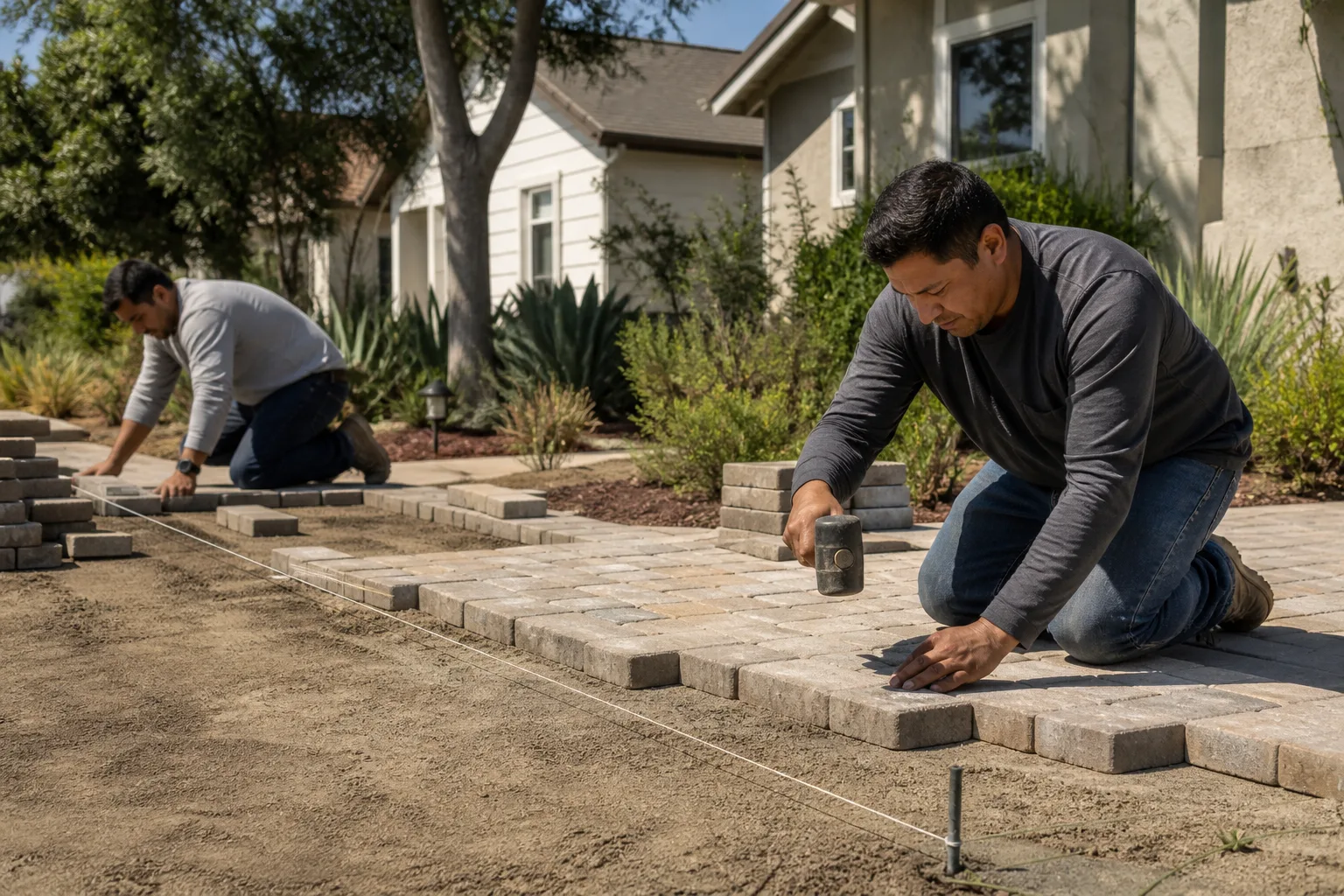
The best repair is the one you never need, and the design of your driveway decides which failures are even possible. Interlocking concrete pavers, set on a properly compacted base with edge restraint and joint sand, are built to flex slightly with the ground and to be lifted and reset when a section fails. That serviceability is the reason troubleshooting a driveway is a conversation at all. On continuous surfaces like poured concrete or asphalt, a crack is a crack, and the fix means cutting or patching, not lifting a stone.
For homeowners in Orange repairing or replacing a driveway, that flexibility is worth keeping. It lets a good contractor fix one bad panel without tearing up the whole surface, and it makes drainage corrections cheaper because the pavers come up and go back down. Whether you’re repairing an existing driveway or specifying a new one, the choice of paver and the way it’s laid down determine whether minor settling stays minor. Our seven-brand paver roster across Belgard, Unilock, Tremron, Techo-Bloc, Cambridge, and Oldcastle is there so you can choose the surface look you want without giving up serviceability. Paver repair and full driveway work also pair naturally with the rest of a property’s exterior, and when a project grows to include more ground work it’s useful to plan it as one scope, which is where bigger work like a coordinated home additions & ADU project begins to overlap the driveway plan.
Common Mistakes to Avoid
- Patching the surface without fixing the base. A new layer of pavers over a shallow or washed-out base fails again by the next rainy season. If the stones rock, the base is the job, not the surface.
- Adding sand without checking drainage. Re-sanding a driveway that pools water hides the problem for a while but the water keeps working its way into the base. Run the hose test first, every time.
- Skipping edge restraint. A driveway without proper edge restraint has nothing to resist thermal expansion, and in Orange’s hot, sunny stretches that opens joints along the sunny side.
- Treating efflorescence as a cleaning problem. Heavy blooming that returns at the same spot is a moisture warning, not a stain. Chasing it with cleaner without checking drainage wastes money.
- Ignoring root intrusion. Resetting pavers over a rising tree root looks fine for one season and then heaves again. Address the root or the joint width, or expect a repeat.
- Accepting a vague proposal. A scope that says “repair pavers” gives you no way to know what you’re buying. Insist on the base, drainage, and edge details in writing.
When to Call a Professional
Call a professional when the pavers rock in panels rather than one or two stones, when water runs toward the garage or stands on the surface after a rain, or when a crack or dip has appeared over a large area. Also call if the base is the suspect, because correcting it means lifting the pavers and re-compacting, not something to tackle by hand. Root intrusion under a driveway and any drainage re-grading around a foundation are jobs for a trained crew. Our technicians have up to 12 years of experience reading these failures and separating a re-sand from a rebuild, and we put the diagnosis and the repair scope in writing so you can compare it honestly. Construction Orange offers free estimates in Orange, with written line-item quotes and fixed pricing with no change orders. Call (844) 797-4821 to schedule yours. We answer 24/7. Fast dispatch from 7am to 7pm, Sunday through Friday.
Frequently Asked Questions
If the stones are solid underfoot and only the joint sand is missing, re-sanding and re-compacting will usually fix it. If a whole panel rocks, the straight edge shows broad dips, or water pools on the surface, you’re looking at a base rebuild. Run the hose and straight-edge test before you call anyone so you know which problem you have. Call (844) 797-4821 for a free estimate and we’ll confirm it in person.
Sinking pavers in Orange usually come from a base that wasn’t compacted deep enough, soil that shrinks during the long dry season and then takes on winter rain, or a localized void where water washed out the aggregate underneath. Sinking in one area points to settling; sinking across a broad panel points to base construction. Either way, the fix is underneath the pavers, not a surface patch. Call (844) 797-4821 for an exact scope.
Not always. A thin, even white film that fades with weather is cosmetic efflorescence, and it’s common on newer pavers. Heavy blooming that keeps returning at the same spot is a moisture warning and usually traces back to a drainage or base issue. Check the drainage path before you spend money on cleaners. Call (844) 797-4821 and we’ll tell you which one you’re seeing.
No. We work from the written estimate, and the estimate sets the final price. That’s why the scope is itemized: base depth, edge restraint, drainage, joint sand, and what’s excluded are all spelled out before work begins. Fixed pricing with no change orders means the number you approve is the number you pay. Call (844) 797-4821 for your written quote.
Some driveway and drainage work requires a permit, and some doesn’t, depending on scope and how the work ties into grading and drainage around the property. We handle the permitting question as part of the estimate and pull what the work requires. If you’re unsure whether your project needs one, ask your city’s building department, then bring the answer to your estimate. Call (844) 797-4821 to schedule.
A re-sand and re-compaction usually takes a day or a few days, depending on the size of the driveway and the number of joints involved. A base rebuild is a larger job because the pavers come up, the base is corrected, and the surface is re-laid and compacted, so it runs longer. We give you a realistic timeline in the written scope. Call (844) 797-4821 for an exact estimate for your Orange driveway.
The Bottom Line

Most paver problems in Orange start underneath the surface, not in the material. Before you let anyone quote a replacement, run the hose and the straight edge, and decide whether you’re facing a base failure, a settling void, or a drainage error. Re-sanding saves a driveway when the stones are firm and only the sand and weeds are the issue. A rebuild is unavoidable when panels rock or water has nowhere to go. Watch for the Orange patterns: thermal expansion gaps, organic staining, and root intrusion. Read efflorescence as a moisture clue, and insist on a written scope that names the base, the drainage, and the edge restraint. One contractor, every phase, from the curb outward, so the fix actually holds.
Call (844) 797-4821 for a free estimate on your driveway and paver repair in Orange. We answer 24/7. Fast dispatch from 7am to 7pm, Sunday through Friday. Written line-item quotes, fixed pricing with no change orders, and a scope you can compare line by line.
Written by the team at Construction Orange.